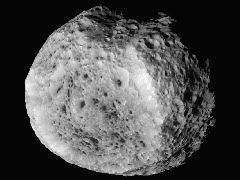
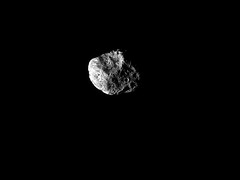
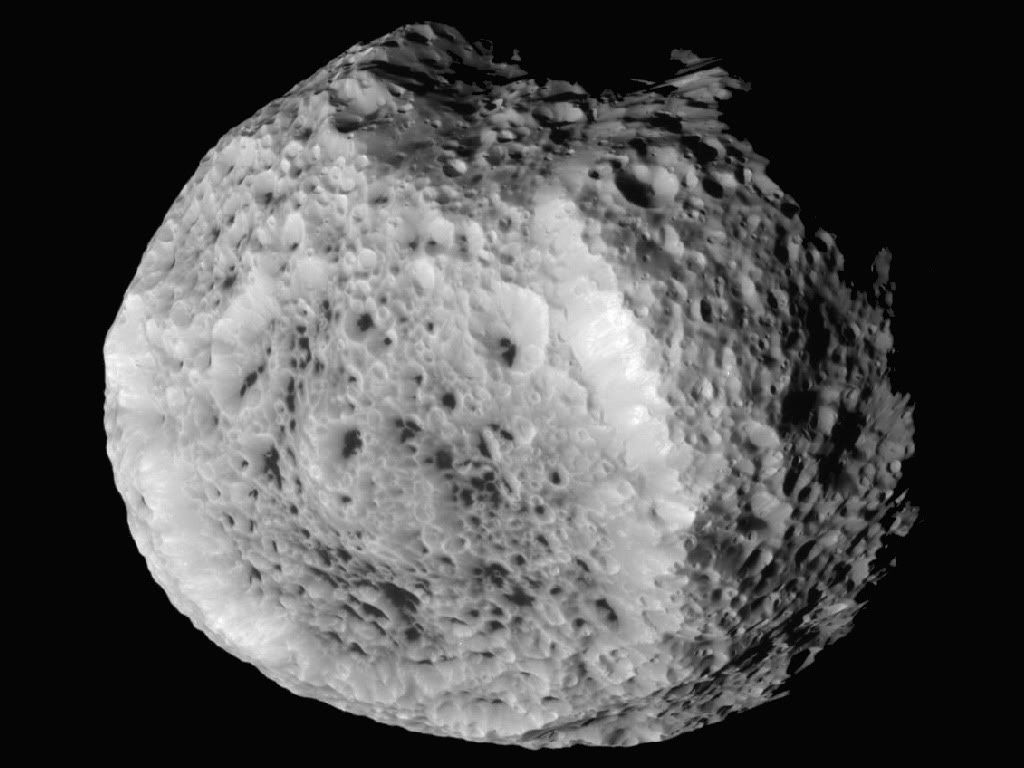
This image of Saturn's irregularly shaped moon Hyperion was taken in visible light with the Cassini spacecraft narrow-angle camera on Oct. 21, 2007, when the spacecraft was approximately 151,000 kilometres from Hyperion and at a Sun-Hyperion-spacecraft, or phase, angle of 111 degrees.
Expand (29kb, 1024 x 768) Credit: NASA/JPL/Space Science Institute
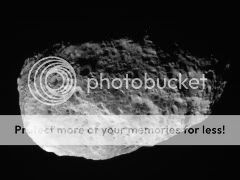
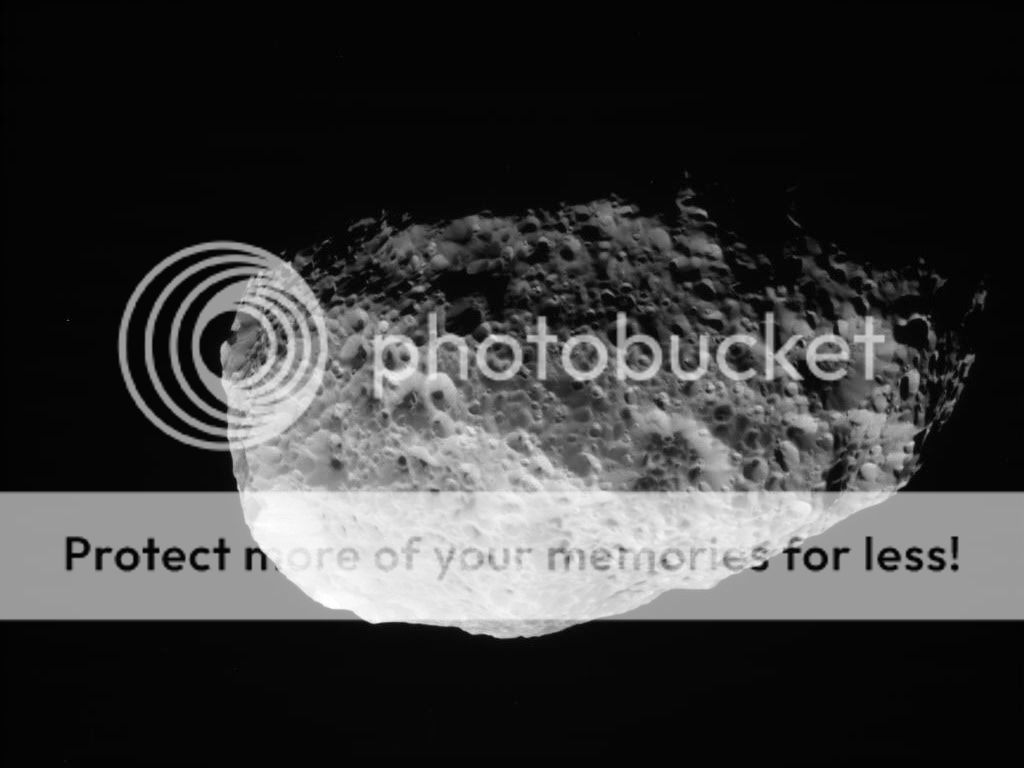
This image of Hyperion was taken in visible green light with the Cassini spacecraft narrow-angle camera on July 23, 2007, when it was approximately 318,000 kilometres away.
This ultraviolet image of Hyperion was taken by the Cassini spaceprobe during the September 2005 close flyby. The view shows topographic and compositional variations on the surface of the moon. The bright regions are exposed water ice on the rim of the main crater.
Expand (131kb, 1024 x 768) Credit: NASA/JPL/Space Science Institute
This is a colour map of a 75 kilometres square piece of Hyperion's surface, and was made by the Visual and Infrared Mapping Spectrometer aboard the Cassini spacecraft during its flyby of Hyperion in September 2005.
Exand (418kb, 1024 x 1024) Credit: NASA/JPL/Space Science Institute
Blue shows the maximum exposure of frozen water, red denotes carbon dioxide ice, magenta indicates regions of water plus carbon dioxide, yellow is a mix of carbon dioxide and an unidentified material.
Scientists on NASAs Cassini mission to Saturn now have a better understanding of why the odd moon Hyperion has such an unusual appearance. The crucial factor in creating the strange, sponge-like appearance of Hyperion appears to be its extremely low density, say Cassini scientists in a research paper being published in the July 5 issue of the journal Nature. The researchers examined Cassini spacecraft images and other data on the moons mass acquired during encounters with Hyperion over the past three years.
Astronomers examining close-up pictures of Hyperion, a large moon of Saturn, say the spud-shaped rock has a "sponge-like appearance" unlike anything seen before. As much as 40 per cent of Hyperion could be porous, they reported in this week's edition of Nature, the British science journal. High-resolution images of Hyperion were sent back to Earth last year and in 2005 by the US space probe Cassini. The probe swooped to within 618 kilometres of the surface.
NASA's Cassini spacecraft has revealed for the first time surface details of Saturn's moon Hyperion, including cup-like craters filled with hydrocarbons that may indicate more widespread presence in our solar system of basic chemicals necessary for life. Hyperion yielded some of its secrets to the battery of instruments aboard Cassini as the spacecraft flew close by in September 2005. Water and carbon dioxide ices were found, as well as dark material that fits the spectral profile of hydrocarbons. A paper appearing in the July 5 issue of Nature reports details of Hyperion's surface craters and composition observed during this flyby, including keys to understanding the moon's origin and evolution over 4.5 billion years. This is the first time scientists were able to map the surface material on Hyperion.
+ Larger image This map shows the composition of a portion of Hyperion's surface. Blue shows the maximum exposure of frozen water, red denotes carbon dioxide ice ("dry ice"), magenta indicates regions of water plus carbon dioxide, yellow is a mix of carbon dioxide and an unidentified material. Image credit: NASA/JPL/University of Arizona/Ames/Space Science Institute + Full image and caption
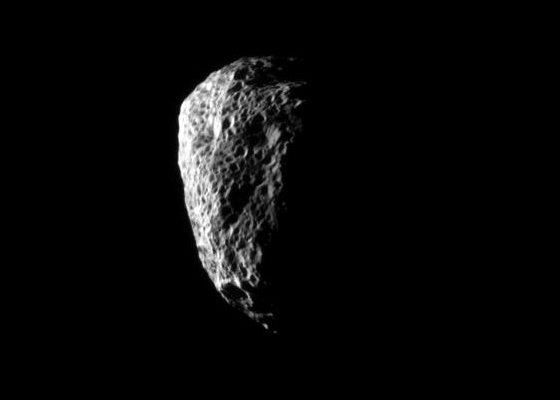
Giant pits cover the impact-eroded face of Hyperion, giving it a spongy appearance. The chaotically tumbling moon is extremely porous, like the moons orbiting in and near Saturn's rings.
Credit: NASA/JPL/Space Science Institute
The image was taken in visible light with the Cassini spacecraft narrow-angle camera on April 12, 2007 at a distance of approximately 1.1 million kilometres from Hyperion and at a Sun-Hyperion-spacecraft, or phase, angle of 46 degrees. Scale in the original image was 7 kilometres per pixel. The image was contrast enhanced and magnified by a factor of two.