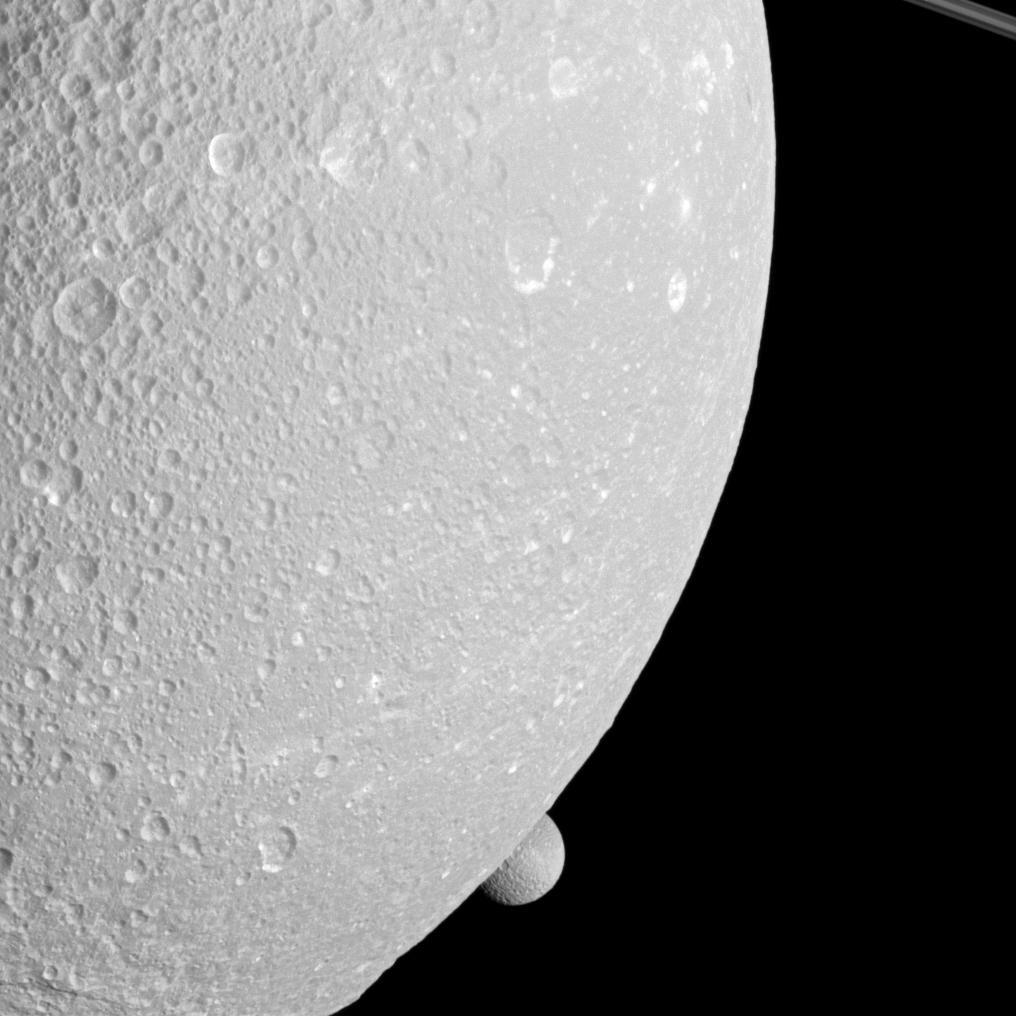
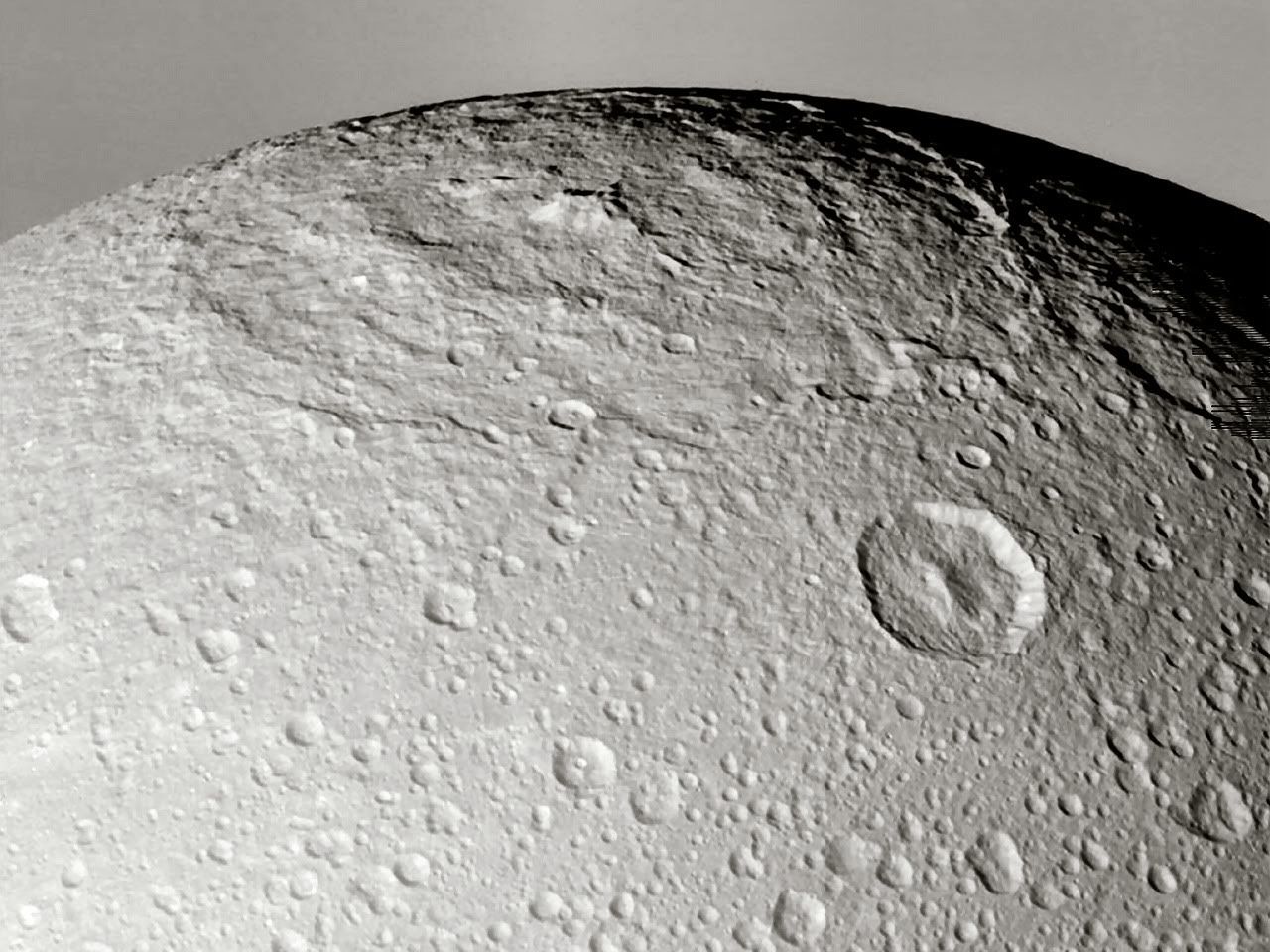
Saturn's icy moon Dione has undoubtedly experienced geologic activity since its formation, as evidenced by the tectonic faults and craters on its surface.
To create this enhanced-colour view, ultraviolet, green and infrared images were combined into a single black and white picture that isolates and maps regional colour differences. This "colour map" was then superposed over a clear-filter image. The origin of the colour differences is not yet understood, but may be caused by subtle differences in the surface composition or the sizes of grains making up the icy soil. This view looks toward the leading hemisphere on Dione.
This image of Dione was taken by the Cassini spaceprobe on September 11, 2008, when it was approximately 832,139 kilometres away. The image was taken using the CL1 and CL2 filters.
This image of Dione was taken in visible light by the Cassini spacecraft on July 21, 2008, when it was approximately 290,000 kilometres away, and at a Sun-Dione-spacecraft, or phase, angle of 89 degrees.
Expand (46kb, 879 x 920) Credit: NASA/JPL/Space Science Institute
The view shows the Saturn-facing side of Dione, with the crater Dido, visible just right of the terminator, below centre. North is toward the top and rotated six degrees to the left. Image scale is 2 kilometres per pixel.
Presented here is a complete set of cartographic map sheets from a high-resolution Dione atlas, a project of the Cassini Imaging Team. The map sheets form a 15-quadrangle series covering the entire surface of Dione at a nominal scale of 1:1,000,000. An index for the atlas is included here, along with an unlabeled version of each terrain section. The map data was acquired by the Cassini imaging experiment. The mean radius of Dione used for projection of the maps is 562.53 kilometres. Names for features have been approved by the International Astronomical Union.
This image of Dione was taken in visible light with the Cassini spacecraft narrow-angle camera on Jan. 3, 2008, when it was approximately 129,000 kilometres away from Dione and at a Sun-Dione-spacecraft, or phase, angle of 87 degrees.
Expand (183kb, 1024 x 768) Credit: NASA/JPL/Space Science Institute
The view captures terrain stretching from about 30 degrees south latitude to about 65 degrees north latitude on the moon's Saturn-facing side. Cassini obtained this view from a position 48 degrees above the equator of Dione. North is up.
This image of the southern hemisphere on Dione's anti-Saturn side was taken in visible light with the Cassini spacecraft narrow-angle camera on Dec. 19, 2007. The image was obtained at a distance of approximately 240,000 kilometres from Dione and at a Sun-Dione-spacecraft, or phase, angle of 44 degrees.
This image of the bright fractures on the trailing side of Dione was taken in visible light with the Cassini spacecraft narrow-angle camera on Nov. 18, 2007, when it was approximately 1 million kilometres away.
This image of Dione was taken in polarised green light by the Cassini spacecraft narrow-angle camera on Sept. 30, 2007,, when it was approximately 197,000 kilometres away, at a Sun-Dione-spacecraft, or phase, angle of 25 degrees.
Expand (140kb, 768 x 1024) Credit: NASA/JPL/Space Science Institute
The view is centred on 9 degrees north latitude, 51 degrees west longitude. North on Dione is up.