* Astronomy


Members Login
User Name
 
Password


Home -> Astronomy News -> Solar System -> Neptune
Post Info
TOPIC: Neptune
Blobrana


K


Posts: 49329
Date: Oct 24 17:30 2009
RE: Neptune


Galileo knew he had discovered a new planet in 1613, 234 years before its official discovery, according to a new theory by a University of Melbourne physicist and alumnus.

"It has been known for several decades that this unknown star was actually the planet Neptune. Computer simulations show the precision of his observations revealing that Neptune would have looked just like a faint star almost exactly where Galileo observed it" - Professor David Jamieson.

But a planet is different to a star because planets orbit the Sun and move through the sky relative to the stars. It is remarkable that on the night of January 28 in 1613 Galileo noted that the "star" we now know is the planet Neptune appeared to have moved relative to an actual nearby star."
There is also a mysterious unlabeled black dot in his earlier observations of January 6, 1613, which is in the right position to be Neptune.

"I believe this dot could reveal he went back in his notes to record where he saw Neptune earlier when it was even closer to Jupiter but had not previously attracted his attention because of its unremarkable star-like appearance"

If the mysterious black dot on January 6 was actually recorded on January 28, Professor David Jamieson proposes this would prove that Galileo believed he may have discovered a new planet.

Source


Blobrana


K


Posts: 49329
Date: Oct 7 18:08 2009
Neptune Trojans


Title: Neptune Trojans and Plutinos: colours, sizes, dynamics, and their possible collisions
Authors: A.J.C. Almeida, N. Peixinho, A.C.M. Correia

Neptune Trojans and Plutinos are two subpopulations of trans-Neptunian objects located in the 1:1 and the 3:2 mean motion resonances with Neptune, respectively, and therefore protected from close encounters with the planet. However, the orbits of these two kinds of objects may cross very often, allowing a higher collisional rate between them than with other kinds of trans-Neptunian objects, and a consequent size distribution modification of the two subpopulations.
Observational colours and absolute magnitudes of Neptune Trojans and Plutinos show that i) there are no intrinsically bright (large) Plutinos at small inclinations, ii) there is an apparent excess of blue and intrinsically bright (small) Plutinos, and iii) Neptune Trojans possess the same blue colours as Plutinos within the same (estimated) size range do.
For the present subpopulations we analysed the most favourable conditions for close encounters/collisions and address any link there could be between those encounters and the sizes and/or colours of Plutinos and Neptune Trojans. We also performed a simultaneous numerical simulation of the outer Solar System over 1 Gyr for all these bodies in order to estimate their collisional rate.
We conclude that orbital overlap between Neptune Trojans and Plutinos is favoured for Plutinos with large libration amplitudes, high eccentricities, and small inclinations. Additionally, with the assumption that the collisions can be disruptive creating smaller objects not necessarily with similar colours, the present high concentration of small Plutinos with small inclinations can thus be a consequence of a collisional interaction with Neptune Trojans and such hypothesis should be further analysed.

Read more (1697kb, PDF)

Blobrana


K


Posts: 49329
Date: Jul 28 13:44 2009
RE: Neptune


The unlabelled black dot in Galileo's observations dated January 6, 1613, has suggested that this particular "fixed star" was Neptune. An Australian physicist has recommended trace element analysis of the spot from the notes of that date, writes Kalyan Ray

Read more

Blobrana


K


Posts: 49329
Date: Jul 18 20:23 2009


Neptune

Average Distance From Sun: 4,504,300,000 Km
Diameter: 49,000 KM
Mass: 1.7135e+01 x Earth Standard
Gravity: 1.05 x Earth Standard
Atmosphere: Very Cold Gases
Moon: 13
Axis tilt 29 degrees.
Neptune Year: 164.79 Earth Years
Neptune Day: 16.11 Earth hours
Neptune is the eighth and last planet from the Sun. Neptune's magnetic field is tilted 47 degrees from the planet's rotation axis, and is offset at least 0.55 radii


Neptune has three narrow orbital rings enclosed in a disc of dust that may reach down to the Neptunian cloud tops. Neptune has two named moons (Triton and Nereid), and six more discovered by the Voyager 2 probe in 1989, of which 1989 N1 (diameter 418 km/260 mi) is larger than Nereid.
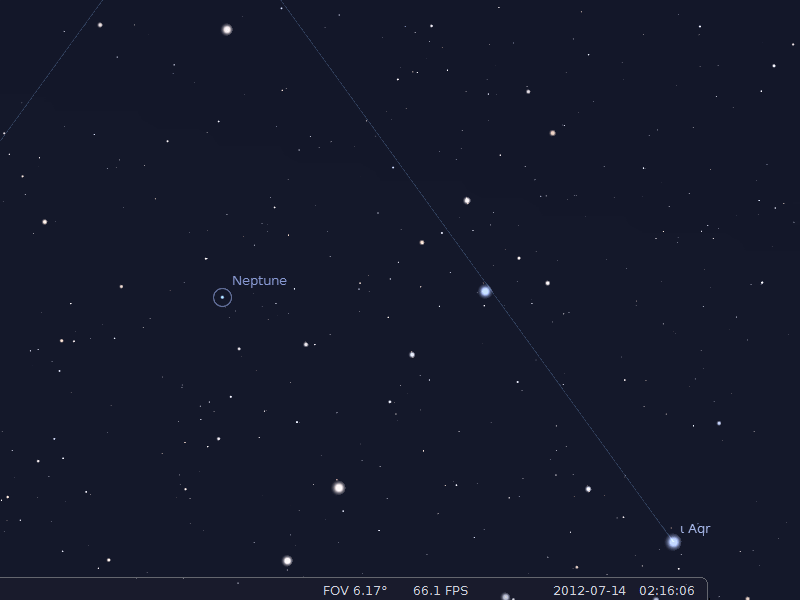
Neptune is an 8th magnitude object visible in binoculars and in 2006 the planet resides in Capricornus, the Sea Goat. It arrives at opposition on August 11, 2006.
Neptune was located on the 23 September 1846 by Galle and D'Arrest after calculations by John Couch Adams and Urbain Jean-Joseph Le Verrier had predicted its existence on the basis that another body must be disturbing the orbit of Uranus. The cameras of Voyager 2, which passed Neptune in Aug 1989, revealed a wide variety of cloud features.
Yes, click this! for large colourmap
Notable

neptune_season.gif
6-year animation
among these were bright polar collars and broad bands in different shades of blue girdling Neptune's southern hemisphere.The blue colouring results from the absorption of red light by the methane in the atmosphere. Another cloud feature is an Earth-sized oval storm cloud, which has been named the Great Dark Spot, and has been likened to the Great Red Spot on Jupiter.
Above and around it, cirrus-type clouds of frozen methane are forming and taking shape, with winds of up to 2,400 kph. Neptune is believed to have a central rocky core covered by a layer of ice.
Mystery solved.
Neptune
Neptune
The interior structures of Uranus and Neptune are radically different from what was previously assumed about these cold, distant planets. Even though they are gas giants, they are different from Jupiter and Saturn.
These two outer planets may have only a thin layer of metallic convecting fluid just under the gassy hydrogen surface. This would explain what causes the magnetic field to be tipped on its side compared to the rotational axis and also explain the "quadrupole" effect. Their magnetic fields are tipped over midway to the equator, and there are two north and two south poles, as if the field were produced by two bar magnets.
The Hubble Space Telescope
Expand
Neptune methane
Neptune Methane Band
captures the distant blue-green world, Neptune, and its satellites in this portrait. Astronomers used Hubbles assortment of filters to pinpoint high altitude clouds floating above the methane rich atmosphere.
Expand
2005-22-c-large_web.jpg
Neptune Enhanced Colour
Expand
Neptune natural colour
Neptune Natural Colour
Hubble Space TelescopeImages have been assembled into a time-lapse movie revealing the orbital motion of the satellites. The icy moons seen in this view are Proteus (the brightest), Larissa, Despina, and Galatea. Neptune had 13 moons at last count. neptune moons
In Roman mythology, Larsissa and Despina were Neptuness daughters.

Neptune Moons
Moon # Radius
(km)
Mass
(kg)
Distance
(km)
Period (days) Discoverer Date
Naiad III29?48,000
0.294
Voyager 21989
Thalassa IV40?50,000
0.311
Voyager 21989
Despina V74?52,500
0.335 
Voyager 21989
Galatea VI79?62,000
0.429
Voyager 21989
Larissa VII104x89?73,600
0.555
Voyager 21989
Proteus VIII200?117,600
1.122 
Voyager 21989
Triton I1,3502.14e+22354,800
5.88
W. Lassell1846
Nereid II170?5,513,400
360.1
G. Kuiper1949
S2002 N1 20?
15686000
1874.8
M. Holman2002
S2002 N2 20?
22337190
2925.6 
M. Holman2002
S2002 N3 20?
22613200
 2980.4
M. Holman2002
S/2003 N1
Psamathe
X
19
46738000
 9136.1
2003
S/2002 N4
60
47279670
 9007.1
2002
Mpeg MovieThis timelapse movieof Neptune was assembled from combining the Hubble Space Telescope images taken over a 15-hour period. The movie shows a dynamic atmosphere and captures the fleeting orbits of Neptunes satellites . The natural colour and enhanced colour views of Neptune were assembled from images in 14 different coloured filters. This allows atmospheric features to be seen above Neptune's methane haze, which gives the planet its blue-green colour.
The animation has four sections, each one corresponding to approximately one rotation of Neptune.neptune movie
Mpeg Movie (1.64Mb mpeg movie) The first section shows Neptune and its largest satellite Triton, which is about as large as our moon. Probably a captured Kuiper Belt object, Triton orbits Neptune in a "backwards" or retrograde path relative to the other major satellites, and opposite to Neptune's rotation. The view is close to what a human eye would see looking through the Hubble Space Telescope.
The second scene zooms in on Neptune, and the colours have been enhanced to better show the subtle detail of clouds in Neptune's atmosphere.
The third scene has the spectral region of light changed from the visible to special methane bands in the near infrared. Most of Neptune's atmosphere becomes very dark, except for high-altitude clouds.
The fourth scene traces the satellite orbits. Four of the small, inner satellites are visible orbiting Neptune. Dutifully obeying Kepler's laws of planetary motion, the outer moons take longer to revolve around Neptune than the inner ones. From outside to inside, these satellites are Proteus, Larissa, Galatea, and Despina. These moons are so faint that only the longest Hubble exposures can capture them.
The outermost layers of Neptune's thick atmosphere do not rotate like a solid body. The polar atmospheric regions finish a full rotation in about 15 hours, while the equatorial regions lag behind, taking more than 18 hours for a complete circuit of the planet.


Rings of Neptune
Name Distance* Width Thickness Mass Albedo
1989N3R 41,900 km 15 km ? ? low
1989N2R 53,200 km 15 km ? ? low
1989N4R 53,200 km 5,800 km ? ? low
1989N1R 62,930 km < 50 km ? ? low


Blobrana


K


Posts: 49329
Date: Jul 18 20:07 2009


Blobrana


K


Posts: 49329
Date: Jul 7 13:32 2009
 

A new theory from an Australian researcher contends that master astronomer Galileo may have discovered Neptune, 234 years before its official discovery.
Professor David Jamieson, Head of the School of Physics has claimed that, buried its annotations in notebooks from 400 years ago, is evidence that Galileo had discovered the planet we now call Neptune.
Prof Jamieson has had his findings published in the journal Australian Physics and presented his theory at the 2009 July Lectures in Physics program at the University of Melbourne last week.
According to Galileo's notebooks, he had been following an unknown star during the years 1612 and 1613 while observing the moons of Jupiter.

Read more

Blobrana


K


Posts: 49329
Date: May 31 11:58 2009
 

Simple incompetence has led more than a few scientists to miss major discoveries. When the 19th-century English mathematician John Adams claimed to have worked out that a new planet would be found in the constellation Aquarius, a simple search of the area would have proved him right. Unfortunately, the job was given to a Cambridge University astronomer named James Challis, who actually saw the planet in 1846 but failed to recognise it. Barely a month later, astronomers in Germany made no such mistake and were duly hailed as the discoverers of Neptune.
Source

Blobrana


K


Posts: 49329
Date: May 9 14:56 2009


Blobrana


K


Posts: 49329
Date: Oct 6 10:26 2008
 

The deep interior of Neptune, Uranus and Earth may contain some solid ice. Through first-principle molecular dynamics simulations, Lawrence Livermore National Laboratory scientists, together with University of California, Davis collaborators, used a two-phase approach to determine the melting temperature of ice VII (a high-pressure phase of ice) in pressures ranging from 100,000 to 500,000 atmospheres.

Read more

Blobrana


K


Posts: 49329
Date: Jul 27 18:43 2008
 

Neptune is at Opposition on the 15th August 2008.
The planet will reach a magnitude of 7.8, which is bright enough for moderate binoculars.

Opposition is the point when Neptune appears opposite to the Sun in the sky. On the 15 August the planet will rise as the Sun sets and will set as the Sun rises providing an entire night of observation. At Opposition the planet comes physically closest (distance to earth: 29.025 AU) to the Earth, and consequently is one of  the best times for viewing the planet.
The moon is new on the 16th and will not interfere with the event.

nep150808
Expand (17kb, 818 x 582)

Position(2000): RA=21h40m48s  Dec=-14°16.0'

Neptune is located in the constellation Capricornus, the Sea Goat, until the year 2010.

1 2 3  >  Last»  | Page of 3 sorted by

Quick Reply
Please log in to post quick replies.
Home -> Astronomy News -> Solar System -> Neptune
Jump To:


Post to Del.icio.usPost to FacebookPost to Digg


Find other message boards
Create your own free forum